<?xml version="1.0" encoding="UTF-8"?>
<?xml-stylesheet type="text/xsl" href="/stylesheets/feed.atom.xml" media="screen"?>
<feed xml:lang="en-US" xmlns="http://www.w3.org/2005/Atom">
  <id>tag:neuroimaging.nd.edu,2005:/news/latest-news</id>
  <link rel="alternate" type="text/html" href="https://neuroimaging.nd.edu"/>
  <link rel="self" type="application/atom+xml" href="https://neuroimaging.nd.edu/news/latest-news.atom"/>
  <id>tag:neuroimaging.nd.edu,2005:/latest</id>
  <title>Human Neuroimaging Center | Latest News</title>
  <updated>2026-04-02T11:42:00-04:00</updated>
  <link rel="alternate" type="text/html" href="https://neuroimaging.nd.edu/"/>
  <link rel="self" type="application/atom+xml" href="https://neuroimaging.nd.edu//news/latest-news.atom"/>
  <subtitle>Explore how neuroscience at Notre Dame integrates disciplines to understand the brain, meaning, and human fulfillment beyond just biology.</subtitle>
  <entry>
    <id>tag:neuroimaging.nd.edu,2005:News/180857</id>
    <published>2026-04-02T11:42:00-04:00</published>
    <updated>2026-04-16T11:42:39-04:00</updated>
    <link rel="alternate" type="text/html" href="https://neuroimaging.nd.edu/news/latest-news/notre-dame-launches-human-neuroimaging-center-to-advance-interdisciplinary-neuroscience-and-insight-into-the-human-mind/"/>
    <title>Notre Dame launches Human Neuroimaging Center to advance interdisciplinary neuroscience and insight into the human mind</title>
    <summary type="text">
      <![CDATA[Aron Barbey, the Andrew J.…]]>
    </summary>
    <content type="html">
      <![CDATA[<figure class="image image-default"><img src="https://al.nd.edu/assets/655092/fullsize/20260123_jlh_neuroscience_meetings_025.jpg" alt="Smiling man in blue suit faces a man at a laptop with charts on a round table in a bright office." width="1200" height="800">
<figcaption>Aron Barbey, the Andrew J. McKenna Family Professor of Psychology, discusses research with Nathan Muncy, assistant research professor in the Department of Psychology. (Photo by Jon L. Hendricks/University of Notre Dame)</figcaption>
</figure>
<p>With a significant new investment, the University of Notre Dame’s <a href="http://al.nd.edu">College of Arts &amp; Letters</a> is launching the <a href="https://neuroimaging.nd.edu/">Human Neuroimaging Center</a> to drive innovation in interdisciplinary neuroscience and uncover how brain networks shape the remarkable capacities of the human mind.</p>
<p>The center’s work explores enduring questions in the psychological and brain sciences, including how the biological foundations of the mind enable learning, resilience, and flourishing — capacities central to the fullness of human life.</p>
<p>Led by <a href="https://psychology.nd.edu/people/aron-barbey/">Aron Barbey</a>, the Andrew J. McKenna Family Professor of Psychology, who joined the Notre Dame faculty last fall, the center advances an integrated vision of modern neuroscience grounded in scientific rigor, humanistic insight, and ethical responsibility.</p>
<figure class="image image-right"><img src="https://al.nd.edu/assets/655093/fullsize/20260302_jlh_veldman_clinic_mri_install_015.jpg" alt="Workers in hard hats and yellow vests secure a large white MRI scanner on a trailer near a new campus building." width="600" height="400">
<figcaption>Workers prepare a freshly delivered MRI system for installation in the Human Neuroimaging Center in the basement of the Veldman Family Psychology Clinic at 501 N. Hill Street in South Bend. (Photo by Jon Hendricks/University of Notre Dame)</figcaption>
</figure>
<p>“Neuroscience opens new ways of understanding the human mind and the lives it shapes,” Barbey said. “Advances in brain imaging now allow us to see the brain with remarkable precision, revealing the constellation of networks that underlie perception, memory, language, and thought. Once uncovered, insights from neuroscience move beyond the laboratory, shaping how learning is defined, how mental illness is understood, and how responsibility and care are imagined.”</p>
<p>Barbey and his research team will utilize advanced neuroimaging techniques — including high-resolution functional and structural MRI, diffusion tensor imaging, and computational modeling — to investigate the foundations of human intelligence.</p>
<p>He joined Notre Dame’s <a href="https://psychology.nd.edu/">Department of Psychology</a> after faculty appointments at the University of Illinois at Urbana-Champaign and the University of Nebraska-Lincoln. At Illinois, he held multiple leadership roles at the Beckman Institute, including director of the Center for Brain Plasticity. He later served as the Mildred Francis Thompson Professor and director of the Center for Brain, Biology, and Behavior at Nebraska.</p>
<p>His previous research — supported by more than $30 million in funding from the National Institutes of Health, the National Science Foundation, the Defense Advanced Research Projects Agency, and several other organizations — has explored how intelligence emerges from the network organization and dynamics of the human connectome, applying methods from cognitive neuroscience, experimental psychology, and computer science.</p>
<blockquote class="pull" style="float: left; border-left: none; border-right: 0.2em solid var(--brand-gold); margin-left: 0px; padding: 1em 1.5em 1em 0;">
<p>“At Notre Dame, I believe we have a remarkable opportunity to lead in neuroscience because of the breadth of expertise on our campus — not only in psychology, and increasingly in neuroscience, but also in the humanities and social sciences.” – Aron Barbey, Andrew J. McKenna Family Professor of Psychology</p>
</blockquote>
<p>Ultimately, his work aims to deepen understanding of the neural foundations of intelligence and to advance innovations in cognitive enhancement, neurorehabilitation, and biologically inspired artificial intelligence. Barbey’s research investigates how the brain’s finite architecture gives rise to the flexibility of human intelligence — our capacity to learn, adapt, and solve the diverse problems we face in life.</p>
<p>The Human Neuroimaging Center, co-located with the <a href="https://veldmanclinic.nd.edu/">Veldman Family Psychology Clinic</a> at 501 N. Hill Street in South Bend, will support a growing group of Notre Dame human neuroscience faculty, including three junior faculty who will arrive this fall, with more new hires planned for the coming years.</p>
<p>Barbey, his team, and other neuroscientists will use a state-of-the-art Siemens Magnetom Cima.X 3 Tesla whole-body MRI system to produce structural, functional, and metabolic brain imaging, enabling characterization of the human connectome with remarkable precision.</p>
<p>“Neuroscience offers a profound new lens through which we can view the human experience — one that enriches our existing strengths in the humanities, arts, and social sciences, offering new ways of developing deep insights about how we think, feel, and interact,” said <a href="https://al.nd.edu/about/people/kenneth-scheve/">Kenneth Scheve</a>, the I.A. O’Shaughnessy Dean of the College of Arts &amp; Letters. “At the same time, this center will help us build meaningful scientific collaborations across campus in a way that establishes Notre Dame as a leader in the holistic study of the human mind.”</p>
<p>The center is organized around seven research themes that investigate how brain networks support the capacities that shape human life — and how this knowledge can be used with care and responsibility:</p>
<ul>
<li dir="ltr" aria-level="1">
<p><strong>Neuroscience of human intelligence</strong> — How do differences in the organization and dynamics of the human connectome shape memory, attention, reasoning, and problem solving?</p>
</li>
<li dir="ltr" aria-level="1">
<p><strong>Neuroscience of lifespan development</strong> — How does connectivity evolve from childhood through adulthood, and how do experiences — including education and embodied practices such as handwriting — influence developmental trajectories?</p>
</li>
<li dir="ltr" aria-level="1">
<p><strong>Neuroscience of belief systems</strong> — How do executive, social, and affective brain networks support belief systems and moral decision making, including participation in social, ethical, and religious practices?</p>
</li>
<li dir="ltr" aria-level="1">
<p><strong>Neuroscience of mental health</strong> — How do changes in brain network function contribute to mental health and neurodevelopmental conditions, and how can insights into these changes advance diagnosis and new approaches to treatment?</p>
</li>
<li dir="ltr" aria-level="1">
<p><strong>Neuroscience of traumatic brain injury (TBI)</strong> — How does TBI disrupt and reorganize the network architecture of the human connectome, and how can neuroimaging guide better diagnosis and treatment protocols in student-athlete and military populations?</p>
</li>
<li dir="ltr" aria-level="1">
<p><strong>Neuroscience of human performance in military service</strong> — How do multiple dimensions of performance — across cognitive, physical, and neurobiological measures — change over the course of military service, and how can long-term measurement help strengthen readiness while supporting the health and resilience of service members?</p>
</li>
<li dir="ltr" aria-level="1">
<p><strong>Neuroscience of brain health promotion</strong> — How can modern scientific interventions — including cognitive training, non-invasive brain stimulation, mindfulness meditation, physical activity, and nutrition — shape brain connectivity to promote brain health and resilience across the lifespan?</p>
<figure class="image image-right"><img src="https://al.nd.edu/assets/655094/fullsize/20260302_veldman_clinic_mri_002.jpg" alt="Construction worker in yellow vest installs a Siemens MRI machine with a laptop on its bed in a room under construction." width="600" height="400">
<figcaption>The Human Neuroimaging Center's new Siemens Magnetom Cima.X 3 Tesla whole-body MRI system in the Human Neuroimaging Center in the basement of the Veldman Family Psychology Clinic. (Photo by Jon L. Hendricks/University of Notre Dame)</figcaption>
</figure>
</li>
</ul>
<p>“The mission of our neuroimaging center is to advance neuroscience through rigorous research that is attentive to the broader human questions that inspire it,” Barbey said, “seeking not only to understand the complex and dynamic networks of the human brain, but also to ensure this knowledge benefits the individuals and the communities that we serve.”</p>
<p>Through these themes, Barbey sees ways for neuroscience to engage directly with broader questions of human development, belief, health, performance, and responsibility — ensuring that scientific advances are interpreted in light of history, culture, and enduring questions of human meaning.</p>
<p>“At Notre Dame, I believe we have a remarkable opportunity to lead in neuroscience because of the breadth of expertise on our campus — not only in psychology, and increasingly in neuroscience, but also in the humanities and social sciences,” he said. “The brain is more than a biological system; it underlies how we think, learn, and relate to one another. Its activity is shaped by biology and experience — including culture, history, family, and community. For that reason, neuroscience matters not only for what it reveals about the brain, but for how its insights enrich learning, promote health, and enable flourishing — in service of human dignity and the good we share.”</p>
<p class="attribution">Originally published by <span class="rel-author">Arts &amp; Letters</span> at <span class="rel-source"><a href="https://al.nd.edu/news/latest-news/notre-dame-launches-human-neuroimaging-center-to-advance-interdisciplinary-neuroscience-and-insight-into-the-human-mind/">al.nd.edu</a></span> on <span class="rel-pubdate">April 02, 2026</span>.</p>]]>
    </content>
    <link rel="enclosure" type="image/jpeg" href="https://neuroimaging.nd.edu/assets/656336/20260123_jlh_neuroscience_meetings_025.jpg" title="Smiling man in blue suit faces a man at a laptop with charts on a round table in a bright office."/>
    <author>
      <name>Arts &amp; Letters</name>
    </author>
  </entry>
  <entry>
    <id>tag:neuroimaging.nd.edu,2005:News/178857</id>
    <published>2026-01-26T12:52:00-05:00</published>
    <updated>2026-03-26T12:15:06-04:00</updated>
    <link rel="alternate" type="text/html" href="https://neuroimaging.nd.edu/news/latest-news/key-to-human-intelligence-lies-in-how-brain-networks-work-together/"/>
    <title>Key to human intelligence lies in how brain networks work together</title>
    <summary type="text">
      <![CDATA[Modern neuroscience understands the brain as a set of specialized systems. Aspects of brain function such as attention, perception, memory, language and thought have been mapped onto distinct brain networks, and each has been examined largely in isolation. While this approach has yielded major advances, it has left unresolved one of the most basic facts about human cognition: its overall unity as an integrated system. Now, researchers at Notre Dame have conducted a neuroimaging study to investigate how the brain is organized and how that integrated system gives rise to intelligence.]]>
    </summary>
    <content type="html">
      <![CDATA[<p>Modern neuroscience understands the brain as a set of specialized systems. Aspects of brain function such as attention, perception, memory, language and thought have been mapped onto distinct brain networks, and each has been examined largely in isolation.</p>
<p>While this approach has yielded major advances, it has left unresolved one of the most basic facts about human cognition: its overall unity as an integrated system.</p>
<p>Now, researchers at the University of Notre Dame have conducted a neuroimaging study to investigate how the brain is organized and how that integrated system gives rise to intelligence.</p>
<p>“Neuroscience has been very successful at explaining what particular networks do, but much less successful at explaining how a single, coherent mind emerges from their interaction,” said <a href="https://psychology.nd.edu/people/aron-barbey/">Aron Barbey</a>, the Andrew J. McKenna Family Professor of Psychology in Notre Dame’s <a href="https://psychology.nd.edu/">Department of Psychology</a>.</p>
<h3>How cognitive ties form ‘general intelligence’</h3>
<p>Psychologists have long known that areas as diverse as attention, perception, memory and language are correlated, forming what they term “general intelligence.” This accounts for how humans function and adapt in a wide range of academic, professional, social and health contexts. It shapes how efficiently we learn, reason and perform in response to a multitude of everyday problems and tasks.</p>
<p>For more than a century, this structure has suggested that cognition is unified at a fundamental level. What has been missing is a theory to explain why such unity exists.</p>
<figure class="image image-left"><img src="https://news.nd.edu/assets/646036/400x/cropped_400_72.jpeg" alt="A man with short brown hair and a slight smile wears a blue plaid suit jacket over a purple button-down shirt with a red pin on his lapel, standing in a modern indoor setting.">
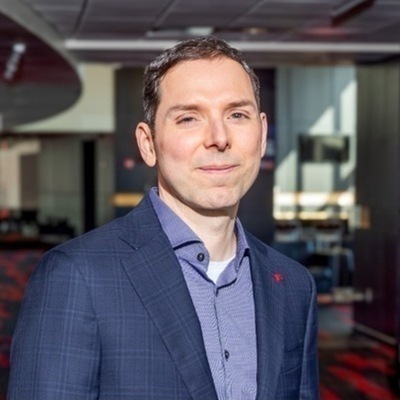
<figcaption>Aron Barbey, the Andrew J. McKenna Family Professor of Psychology in Notre Dame’s Department of Psychology, is also the director of the Notre Dame Human Neuroimaging Center and the Decision Neuroscience Laboratory.</figcaption>
</figure>
<p>“The problem of intelligence is not one of functional localization,” said Barbey, who is also the director of the <a href="https://neuroimaging.nd.edu/">Notre Dame Human Neuroimaging Center</a> and the <a href="https://www.decisionneurosciencelab.org/lab-members/">Decision Neuroscience Laboratory</a>. “Contemporary research often asks where general intelligence originates in the brain — focusing primarily on a specific network of regions within the frontal and parietal cortex. But the more fundamental question is how intelligence emerges from the principles that govern global brain function — how distributed networks communicate and collectively process information.”</p>
<p>Barbey and his research team, including Notre Dame graduate student and lead author <a href="https://psychology.nd.edu/people/graduate-students/ramsey-wilcox/">Ramsey Wilcox</a>, investigated the predictions of the unifying framework, called the Network Neuroscience Theory. <a href="https://www.nature.com/articles/s41467-026-68698-5">Their study</a> was recently published in the journal Nature Communications.</p>
<h3>The Network Neuroscience Theory</h3>
<p>General intelligence is not itself a skill or strategy, the researchers argued. It is a pattern — the tendency for diverse abilities to be positively correlated. The study argues that this pattern reflects differences in how efficiently brain networks are organized and work together.</p>
<p>To test this claim, the cognitive neuroscientists analyzed brain imaging and cognitive data from one of the largest studies conducted to date, examining 831 adults in the <a href="https://www.humanconnectome.org/">Human Connectome Project</a>, along with an independent sample of 145 adults in the INSIGHT Study, which was funded by the <a href="https://www.iarpa.gov/research-programs/sharp">Intelligence Advanced Research Projects Activity’s SHARP program</a>. The researchers integrated measures of both brain structure and function to enable a more precise characterization of the human brain.</p>
<p>Rather than identifying intelligence with a particular cognitive function or brain network, the Network Neuroscience Theory characterizes it as a property of how the brain works as a whole. In this view, intelligence reflects how brain networks are coordinated and dynamically reconfigured to solve the diverse problems we encounter in life.</p>
<p>This research represents an important shift, according to Barbey and Wilcox.</p>
<p>“We found evidence for system-wide coordination in the brain that is both robust and adaptable,” Wilcox said. “This coordination does not carry out cognition itself, but determines the range of cognitive operations the system can support.”</p>
<p>“Within this framework, the brain is modeled as a network whose behavior is constrained by global properties such as efficiency, flexibility and integration,” Wilcox said. “These properties are not tied to individual tasks or brain networks, but are characteristics of the system as a whole, shaping every cognitive operation without being reducible to any one of them.”</p>
<p>“Once the question shifts from where intelligence is to how the system is organized,” Wilcox noted, “the empirical targets change.”</p>
<h3>Intelligence as a globally coordinated system of networks</h3>
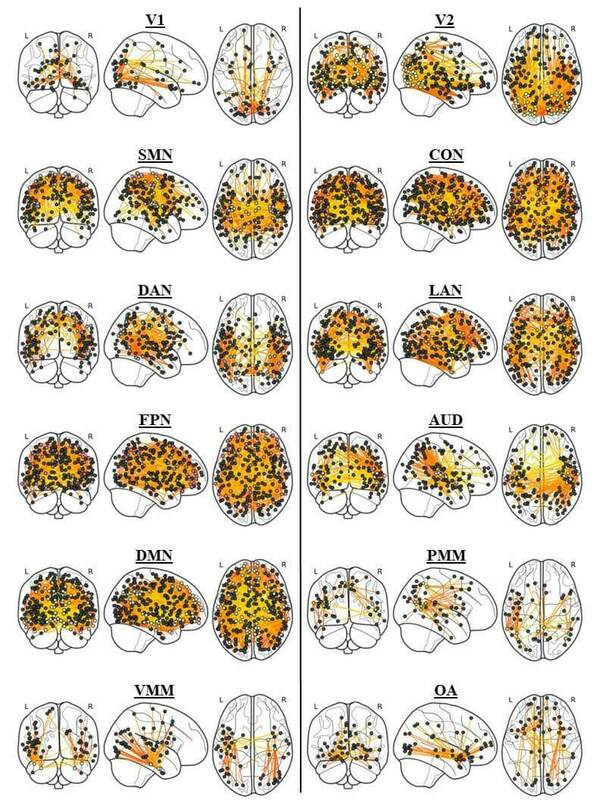
<p>The researchers found evidence to support four predictions of the Network Neuroscience Theory.</p>
<figure class="image image-right"><img src="https://news.nd.edu/assets/646037/predictive_brain_connections.jpg" alt="Twelve brain diagrams show anterior, lateral, and superior views. Each displays numerous black and white nodes connected by yellow-orange-red lines, illustrating distinct brain connectivity patterns." width="600" height="800">
<figcaption>This image illustrates that brain connections predictive of human intelligence are distributed throughout the entire brain, rather than confined to a single region or network. Different brain regions are organized by the functions they support: V1, the main vision center; V2, the secondary vision center; SMN, movement and touch; CON, task control and monitoring; DAN, focusing attention; LAN, language and speaking; FPN, problem-solving and thinking; AUD, hearing; DMN, daydreaming and “resting” mind; PMM and VMM, combining different senses; and OA, emotions.</figcaption>
</figure>
<p>First, the theory predicts that intelligence is not localized to a single brain network but arises from processing distributed across multiple networks. Intelligence, therefore, depends on how the brain manages the division of labor across different networks and combines them as needed.</p>
<p>Second, for the brain to manage this distributed processing, it requires integration and effective long-range communications. To synchronize those efforts, Barbey said, there is “a large and complex system of connections that serve as ‘shortcuts’ linking distant brain regions and integrating information across the networks.” These pathways connect structurally distant areas of the brain, enabling efficient communication and supporting coordinated processing across the system.</p>
<p>Third, effective integration requires regulatory control that coordinates interactions among networks by shaping how information flows throughout the brain. These areas serve as regulatory hubs, reaching out to other networks to orchestrate the brain’s ongoing activities. They selectively recruit the appropriate networks for the specific task at hand — whether it be piecing together subtle clues to make sense of a problem, learning a new skill or deciding whether a situation requires careful deliberation or a rapid, intuitive response.</p>
<p>Finally, Barbey said that general intelligence depends on the brain’s ability to balance local specialization with global integration. In other words, the brain functions best when tightly connected local clusters communicate well, but are still able to link to distant regions of the brain across short communication paths. This makes the most effective problem-solving possible, according to the co-authors.</p>
<p>The research suggests that intelligence is unified not because the brain relies on a single general-purpose processor, but because the same organizational principles shape how all cognitive functions work together.</p>
<p>Across both datasets, individual differences in general intelligence were consistently associated with these system-level properties. No single region or canonical “intelligence network” accounted for the effect.</p>
<p>“General intelligence becomes visible when cognition is coordinated,” Barbey noted, “when many processes must work together under system-level constraints.”</p>
<h3>Applications for artificial intelligence</h3>
<p>The implications of this study extend beyond intelligence research, he added. By grounding cognition in large-scale organization, the study offers a principled account of why the mind is unified at all.</p>
<p>This framework helps explain why intelligence develops broadly during childhood, declines with aging and is particularly sensitive to diffuse brain injury. In each case, it is large-scale coordination — not isolated function — that changes.</p>
<p>The findings also inform ongoing debates about artificial intelligence and how AI models are developed. If general intelligence in humans arises from system-level organization rather than from a dedicated general-purpose mechanism, then achieving general intelligence in artificial systems may require more than the accumulation or scaling of specialized capabilities.</p>
<p>“This research can push us into thinking about how to use design characteristics of the human brain to motivate advances in human-centered, biologically inspired artificial intelligence,” Barbey said.</p>
<p>“Many AI systems can perform specific tasks very well, but they still struggle to apply what they know across different situations.” Barbey said. “Human intelligence is defined by this flexibility — and it reflects the unique organization of the human brain.”</p>
<p>The research was conducted with co-authors Babak Hemmatian and Lav Varshney of Stony Brook University.</p>
<p><em><strong id="docs-internal-guid-911e8f44-7fff-2337-e908-765e57dc620b">Contact: Tracy DeStazio,</strong> associate director of media relations, 574-631-9958 or <a href="mailto:tdestazi@nd.edu">tdestazi@nd.edu</a></em></p>
<p class="attribution">Originally published by <span class="rel-author">Tracy DeStazio and Carrie Gates</span> at <span class="rel-source"><a href="https://news.nd.edu/news/key-to-human-intelligence-lies-in-how-brain-networks-work-together/">news.nd.edu</a></span> on <span class="rel-pubdate">January 26, 2026</span>.</p>]]>
    </content>
    <link rel="enclosure" type="image/jpeg" href="https://neuroimaging.nd.edu/assets/647001/brain_image.jpg" title="A blue glowing human brain is rendered in profile against a black background, clearly showing the cerebrum and cerebellum."/>
    <author>
      <name>Tracy DeStazio and Carrie Gates</name>
    </author>
  </entry>
</feed>