Research
The Human Neuroimaging Center investigates the human connectome — the dynamic constellation of connections through which information flows and is represented across the brain. By studying this organization, we aim to understand how mental capacities emerge, develop throughout life, become altered by mental illness, and can be strengthened through neuromodulation and healthy lifestyle practices.
Neuroscience of Human Intelligence
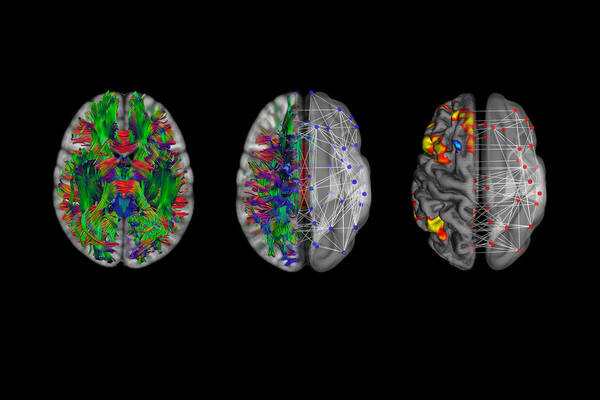
Research at the center examines how individual differences in the organization and dynamics of the human connectome shape facets of intelligence — from memory and attention to complex reasoning and problem-solving. By studying the brain’s network architecture and mapping individual connectomes with precision methods, we aim to identify the network properties that underlie variation in cognitive ability and the principles that enable learning, resilience, and human flourishing.
Neuroscience of Lifespan Development

We study how connectivity evolves from childhood through adulthood, and how experience — including education and embodied practices such as handwriting — influences these developmental trajectories. By examining how learning and attention interact with developing network architecture, we seek to understand how early patterns of organization support later cognitive capacities and when neural systems are most responsive to change.
Neuroscience of Belief Systems

Beliefs are supported by brain networks that integrate executive, social, and affective functions. We study how participation in structured social practices — including religious practice — is associated with changes in network organization and dynamics. By examining how network integration and coherence relate to moral judgment and decision-making, we aim to understand how stable, enduring belief systems are instantiated in the human connectome.
Neuroscience of Mental Health

Psychiatric and neurodevelopmental conditions can be understood as altering brain network organization and dynamics. Our work focuses on how changes in network function — especially within networks supporting cognitive control — affect the brain’s capacity for flexible, adaptive functioning. We aim to study a wide range of clinical conditions — from depression and autism to rare genetic syndromes — and to connect network properties to symptom profiles and treatment outcomes, informing models of risk, diagnosis, and clinical care.
Neuroscience of Traumatic Brain Injury (TBI)

We investigate how TBI disrupts and reorganizes the network architecture of the human connectome, employing neuroimaging and computational modeling methods to map the evolution of injury and the time course of recovery. By studying NCAA Division I athletes, English and Welsh rugby players, and military service members, we aim to identify patterns of vulnerability and resilience, guiding the design of improved rehabilitation strategies and safer return-to-play and return-to-duty protocols.
Neuroscience of Human Performance in Military Service

The center brings together interdisciplinary research to examine how brain and behavioral systems change across the course of military service. Using longitudinal measurement and advanced modeling, we track trajectories of performance, stress regulation, and recovery over time rather than relying on single assessments or fixed thresholds. This work aims to identify key indicators of change that can inform readiness and health systems in ways that strengthen performance and support military service members.
Neuroscience of Brain Health Promotion

We aim to establish interventions that modulate brain function, shaping the connectivity and dynamics of brain networks to promote learning and resilience throughout life. We investigate a wide range of interventions to promote cognitive performance, including skill-based cognitive training, non-invasive brain stimulation, mindfulness meditation, physical activity and aerobic fitness, and diet and nutrition. A central aim of our work is to leverage the combined effects of these interventions through the design of multimodal protocols, with an interest in developing comprehensive interventions that are tailored to the needs of the individual.